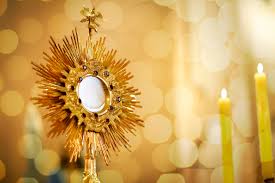
Here’s a multiple-choice question… What percentage of Catholics believe in the Eucharist?
A). 100%
B). 82%
C). 56%
D). 31% or
E). 14%
If you guessed “D” you are are correct. This was confirmed this past July through a study done by the Pew Research Center (Source: Boston Pilot). On the one hand how tragic it is that only 31% (that’s less than 1/3 of all Catholics) believe in the “Real Presence” of Jesus – that He is truly present Body, Blood, Soul, and Divinity in the Eucharist under the form of what appears to be bread and wine. If the Eucharist is the “Source and Summit of the Christian Life” (which it most certainly is) as declared in Catechism 1324 and by Pope Paul VI in 1964 under Vatican II’s Dogmatic Constitution on The Church # 11, and knowing that sad statistic, then something isn’t right here. It doesn’t make sense. Actually, there’s something seriously wrong when 7 out 10 Catholics don’t believe in the Eucharist, and the unbelievers could be sitting right next to us in the pew. Is it a lack of teaching, a lack of understanding, a lack of practice, or a combination of all three? Yes. Yes, and yes!
It’s very apparent and evident we are in a faith crisis. But now there is a tremendous opportunity to change that and to strengthen our belief in the Real Presence of Jesus Christ. It’s now a time for a Eucharistic Renewal within the Catholic Church. But it begins within our own hearts. We are in a new year and a new decade to “Unleash the Gospel,” the mission of my own Archdiocese of Detroit pioneered under the leadership of Archbishop Allen Vigneron, the newly elected Vice President of the U.S. Bishops (USCCB). While there can be a renewal in belief and teaching, one way to “Unleash the Gospel” and thereby put it into practice, is through Eucharistic Adoration, which can be done at a local parish near you (here in the U.S. or here in Michigan).
What is Eucharistic Adoration? It is simply, prayerfully, and humbly adoring Jesus’ Presence in the Eucharist. This can be done in silence or in the form of Praise & Worship (i.e. Awaken) either in the parish church or chapel. During Eucharistic Adoration, Jesus is placed and held in a monstrance, which is a metal sunburst, that stands appropriately and prominently on the altar. What if we took some time in silence during adoration to pray for an increase in vocations to the priesthood, religious life, marriage, and an end to abortion? What could happen? What if spending some time with our Lord humbly on our knees better helped us to prepare to receive Jesus more worthily and gratefully at Mass? If we have received you, Jesus, too casually or unworthily, we are sorry and ask for your mercy and forgiveness (1 Cor. 11:27-32). What if we prayed in reparation for the sacrilegious desecrations done to the Eucharist, especially most recently committed in Asia? (Source: Asia News). What if families spent time together to pray for each other and their needs? What would happen to individuals, families, and our Church? I believe it would be transformed. Pope Francis stated, “Without the Eucharist, every effort of the Church is vain.” What would happen to our world if more people spent time in Eucharistic adoration? I believe it would be transformed and, of course, for the better. Pope Francis proclaimed, “let yourself be transformed by the Eucharist.”
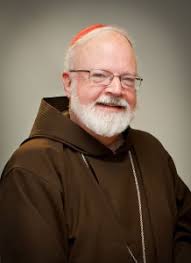
One person who has been transformed by believing, celebrating, and receiving the Eucharist is Cardinal Sean O’Malley of the Archdiocese of Boston who has been inspired to take up the clarion call to “Unleash the Gospel” in his own archdiocese. Just last month he declared a “Year of the Eucharist” beginning this Holy Thursday (April 9th) until Corpus Christi Sunday (June 6th) of the following year (2021) which will be accompanied by a Eucharistic Congress from June 3rd – June 6th, 2021.
Where do you and I stand in our relationship to the Eucharist? Are we transformed with a firm belief to go out as disciples of Jesus Christ in giving loving witness to others, or do we struggle in faith like many others as shown by the recent statistic? Do we hope to regain belief that we may have lost? Is this something that you and I could bring to prayer and focus on as a Lenten Challenge next month when Lent begins on Ash Wednesday, February 26th?
In addition, have you already been impacted in some way by Jesus in the Eucharist? Have you already found renewal in your spiritual life through the Eucharistic Presence of Jesus Christ? If so, how? If compelled, feel free to share below. In my own spiritual life, I found being in silence with the Eucharist helped me to discern my vocation to priesthood. The Eucharist also inspires me to preach, calms me down, and gives me the strength to persevere with courage to meet the day’s demands in the midst of a noisy, busy world.
Furthermore, there is an abundance of resources about the Eucharist available at our fingertips. Are there any that have touched your heart in a powerful way? Again, if comfortable, feel free to share your personal testimony in the “Reply Section.” Below are six resources on the Eucharist that would be greatly beneficial in renewing our belief and devotion to the Eucharistic Jesus. First, is a transforming chapter from John’s Gospel. Second, is Pope St. John Paul’s, “Encyclical Letter on the Eucharist,” which I enjoyed reading through a parish-led study years ago, and there are a few others.
Jesus, you are present in all of the tabernacles of the world. We pray for the conversion and transformation of hearts first beginning with our own hearts and also for those who have stopped believing and receiving. If we have been away or failed in our belief, today may we renew our hearts and return to you, Jesus, you who are the miracle made present in the Eucharist at every Mass, you who inspire in our souls to have “the burn to return” back home to your bride that is home to the Catholic Church and home to your unconditional loving and merciful presence in the Eucharist.
Jesus your love is made present at the cross and poured out for us in the Eucharist too. Your saintly daughter, Mother Teresa of Calcutta once said, “when you look at the crucifix, you understand how much Jesus loved you then. When you look at the Sacred Host, you understand how much Jesus loves you now.” Right now help us to redirect our focus on you, to believe in your Real Presence and love you. Your servant, our Holy Father, Pope Francis, once said about you: “In the Eucharist we receive the grace to love.” Jesus, we renew our love for you today. Continue to heal us and nourish us with your Body and Blood. Like the boy’s father who cried out in Mark’s Gospel (Mk. 9:24), “I do believe, help my unbelief!”Amen!
Resources:
1. 7 Secrets of the Eucharist, by Vinny Flynn
2. 20 Answers: Eucharist, by Trent Horn
3. “Bread of Life Discourse” > John 6
4. “Encyclical Letter on the Eucharist” (Eucharistia de Ecclesia), by St. John Paul II, 2003
5. Jesus and the Jewish Roots of the Eucharist, by Dr. Brant Pitre (in CD or MP3 form)
6. The Lamb’s Supper: The Mass As Heaven on Earth, by Dr. Scott Hahn
“When [St. Teresa] heard people say they wished they had lived when Christ walked on this earth, she would smile to herself, for she knew that we have Him as truly with us in the Most Holy Sacrament as people had Him then, and wonder what more they could possibly want.” – St. Teresa of Avila, The Way of Perfection

 "Speak The Truth with Love," A Catholic Blog by Fr. Jeff Allan
+J.M.J.
Dear Fr. Allan, Thanks for being a priest, and providing the Sacraments and Church teaching, and for your above column on Returning Home to the Eucharist, as well as innumerable thanks for the examples of so many devoted to our Eucharistic Lord, including that I noticed Archbishop Vigneron singing “At the Lamb’s High Feast,” at the Basilica of the National Shrine of the Immaculate Conception, during Pope Benedict XVI’s Easter Visit in 2008. Also, one of my favorite quotes from the Catechism of the Catholic Church is CCC #1376 on Transubstantiation, which my mom (a convert from Finnish Lutheranism) explained to me when I was five. Also, a Church history book that I have indicates that the technical term “Transubstantiation” was first used in a Church Council before the time of St. Thomas Aquinas (who, among other great works, produced precious Eucharistic hymns, such as “Adoro Te Devote”), but in going back to early Church Fathers and Doctors of the Church (such as St. Ambrose, and St. John Chrysostom), as well as examining Catholic Scriptures, one can see that the belief in transubstantiation goes back to the Gospels (seeing for example the Gospel of St. John Chapters 1, and 6, Gospel of St. Luke Chapter 1 reminding us that with God all things are possible, as well as institution of the Eucharist accounts of the Last Supper), even when that technical term was not in use. Also, and of course I could be wrong, I’m a bit uncomfortable with the use of transforming in this context, as it sometimes looks like a move away from the dogma of transubstantiation. Also, in Finite and Eternal Being by St. Edith Stein (a.k.a. St. Teresa Benedicta of the Cross), she differentiates between form and substance, and I’m wondering about St. Paul’s saying that its no longer I who live but Christ who lives in me, is he saying that when I consume Christ, He consumes me, so that maybe in some tiny way we are transubstantiated by Him? Thanks for your consideration.
Mrs. Richard Avian (Carol Avian)
LikeLike
Hi Carol. Appreciate your comment. I used the word, “transformed” as a way to say that we are transformed in our minds, hearts, and souls when we not only believe in Jesus’ presence in the Eucharist, but also when we simply spend time with him in front of the Tabernacle, in Eucharistic Adoration, and also in a spirit of “thanksgiving” (since the “Eucharist” means thanksgiving) after we have received Him at Mass. We are changed or transformed by Jesus through these encounters, and I believe that’s an incredibly awesome mystery. To say that we are transformed by this Eucharistic Encounter all the more affirms the Catholic Church’s teaching on transubstantiation – that the bread and wine at Mass become the Eucharist as the Body, Blood, Soul, and Divinity of Jesus Christ.
Carol, you raise a good question at the end too. Your reference to St. Paul’s quote that “it is no longer I who live but Christ who lives in me” refers to Gal. 2:20. I wouldn’t say that we are transubstantiated. That would mean that we become the Eucharist ourselves. That’s not what happens. So we don’t become other Jesus,’ but as we know, we still maintain our personal identity and individuality yet are united and communed with Christ in a real, spiritual way. This Scripture quote when related to the Eucharist has a very powerful, spiritual impact. When we receive the Eucharist, provided that we receive Jesus in a state of grace (no mortal sin), we also receive the sacramental grace accompanied with it, which changes or transforms our souls. This affects how we live, our prayer life, how we treat others, how much we love our neighbor, and we have the gift of free will to choose or not. Could this quote from St. Paul also refer to the crucifixion? Yes, and what does that teach us? That Christ died, and that we are to die to ourselves through mortification (i.e. self denial/detachment) in imitation of Christ. These are just a couple of points, and I’m just “scratching the surface.” Much more could be said and discovered. May all of us continue to “put out into the deep” and lower our nets for a catch (Lk. 5:4).
LikeLike
I offer Holy Communion to patients at Lake Huron Medical Hospital ( formally Mercy Hospital ) twice a week. I pray before the Tabernacle, that Jesus be in me with his calming presence as I offer His most precious body to the patients.
He hasn’t failed me yet.
Walt
LikeLike
Walt – Great to hear from you! 🙂 Thanks for your faith-filled witness. May God continue to bless your wonderful ministry to the patients at the hospital.
LikeLike
+J.M.J.
As a follow-up to my e-mail above, I’m sorry, but I forgot to sign out as I normally would.
In caritatae Christi,
Mrs. Richard Avian (Carol Avian)
LikeLike