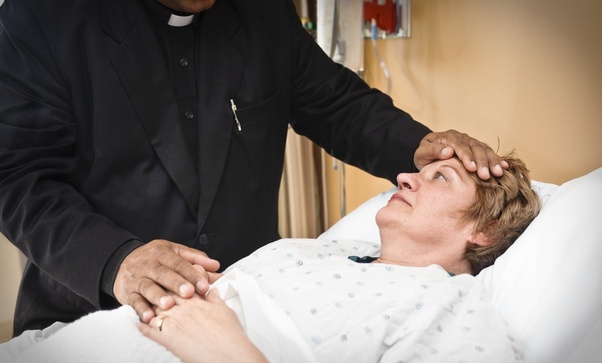
“Last Rites! Last Rites! I want Last Rites!” Have you ever heard of that phrase, “Last Rites” before? Do you know what it means? “Last Rites” is a pre-Vatican II term that refers to the following three elements of spiritual care for a dying person that is administered by a bishop or a priest of the Catholic Faith and which can be applied to someone of the Orthodox Faith as well. The elements include: 1). The Sacrament of The Anointing of The Sick (also called “Extreme Unction” right before death) and is accompanied by 2). The ritual prayers of the Commendation for The Dying as well as 3). The Prayers for The Dead. Depending on whether a dying person is awake and strong enough to participate, the priest or bishop can also hear the dying person’s confession, and any commissioned Extraordinary Minister of The Eucharist (EME) can administer Viaticum (last Holy Communion before death).
One of the spiritually rich experiences I have been blessed with as a priest-chaplain is to minister to the sick and dying on a regular basis in a hospital setting. The encounters with the patients, though they often include the families and sometimes even the medical staff, allow me to bring the love and mercy of Jesus Christ to them in a sacramental way, to prepare them for death, and to bring their souls home to God.
God has given the Catholic Church a gift in what families often request for a dying loved one, which are the “Last Rites.” But there is another treasure of the Catholic Church that many do not know about for a dying person, and because they don’t know about it, they don’t ask for it. It’s called an “Apostolic Pardon,” a.k.a. the “Apostolic Blessing” or “Last Blessing.”
Q: What is the Apostolic Pardon?
It is an indulgence that is given for the remission of temporal punishment due to sin. The focus of the Apostolic Pardon is that it gains the complete pardon or remission of temporal punishment due to sin already forgiven by the Sacrament of Confession/Reconciliation (which includes the reception of absolution as well as the doing of penance). The Apostolic Pardon does not forgive sins by the act of absolution; it deals only with the punishment (purgation) due for those sins that have already been sacramentally forgiven. While confession forgives the eternal punishment for sin, the indulgence attached to the Apostolic Pardon forgives temporal punishment due to sin.
Q: What is an indulgence?
“An indulgence is a remission before God of the temporal punishment due to sins whose guilt has already been forgiven, which the faithful Christian who is duly disposed gains under certain prescribed conditions through the action of the Church which, as the minister of redemption, dispenses and applies with authority the treasury of the satisfactions of Christ and the saints” and which “may be applied to the living or the dead” ( Catechism of The Catholic Church > CCC 1471).
Q: When is the Apostolic Pardon given?
The Apostolic Pardon is given in situations when the individual is in danger of death and takes place usually after absolution from the Sacrament of Confession/Penance/Reconciliation. Here is another example of when the Apostolic Pardon could be given:
1. Confession > 2. Anointing of The Sick > 3. Viaticum > 4. Ritual Prayers for The Commendation of The Dying > 5. The Apostolic Pardon (usually the last spiritual gift given to the dying person).
Q: Who can ask for the Apostolic Pardon?
While the priest or bishop may or may not plan to give the dying patient the Apostolic Pardon, the family member can request it (on behalf of the dying patient, especially if the person is incapacitated or unconscious), or the dying patient can ask for it.
Q: Who can receive the Apostolic Pardon?
A living person who is dying/in danger of death, but not a deceased person (corpse). Just like the sacraments are only for the living, so too is the Apostolic Pardon for the living (dying person). In addition, it can be given to those who are living yet incapacitated or unconscious like those on the ventilator in the Intensive Care Unit (ICU), those with stage 4 or 5 cancer, for example, those in hospice, those on their death bed, and simply given to those at the hour of their death.
Q: Who can give the Apostolic Pardon?
A priest or a bishop
Q: What are the words of the Apostolic Pardon?
a. “Through the holy mysteries of our redemption, may almighty God release you from all punishments in this life and in the life to come. May He open to you the gates of paradise and welcome you to everlasting joy,” or
b. “By the authority which the Apostolic See has given me, I grant you a full pardon and the remission of all your sins in the name of the Father, and of the Son, + and of the Holy Spirit,” or
c. Older Version: “By the Faculty which the Apostolic See has given me, I grant you a plenary indulgence and the remission of all your sins, and I bless you. In the Name of the Father and the Son + and the Holy Spirit. Amen,” or
d. It can be said in Latin too, which is the universal language of the Church, as well as other languages, of course. The two most common options are “a” or “b.” I use option “a.”
Source: Wikipedia
Q: What if you can’t get a priest or bishop to give the Apostolic Pardon before the person dies?
The Handbook of Indulgences #28 states: “Priests who minister the sacraments to the Christian faithful who are in a life-and-death situation should not neglect to impart to them the apostolic blessing, with its attached indulgence. But if a priest cannot be present, holy mother Church lovingly grants such persons who are rightly disposed a plenary indulgence to be obtained in articulo mortis, (at the approach of death), provided they regularly prayed in some way during their lifetime. The use of a crucifix or a cross is recommended in obtaining this plenary indulgence. In such a situation the three usual conditions required in order to gain a plenary indulgence are substituted for by the condition ‘provided they regularly prayed in some way.’
Q: What are the 3 usual conditions of gaining a plenary indulgence?
The Catholic Encyclopedia explains the Apostolic Pardon: The anointing [of the sick] is ordinarily succeeded by the conferring of the Apostolic benediction, or “last blessing,” as it is commonly called. To this blessing a plenary indulgence is attached, to be gained, however, only at the hour of death, i.e. it is given nunc pro tunc (now for then). It is conferred in virtue of a special faculty granted to the bishops and by them delegated quite generally to their priests. The conditions requisite for gaining it are the invocation of the Holy Name of Jesus at least mentally, acts of resignation by which the dying person professes his willingness to accept all his sufferings in reparation for his sins and submits himself entirely to the will of God. … The words of St. Augustine are in point: “However innocent your life may have been, no Christian ought to venture to die in any other state than that of the penitent.”
Furthermore, below are the regular or usual conditions for receiving a Plenary Indulgence as described by the Vatican:
- Be in the state of grace at least at the time the indulgenced work is completed.
- Have the interior disposition of complete detachment from sin, even venial sin;
- Have sacramentally confessed their sins;
- Receive the Holy Eucharist (it is certainly better to receive it while participating in Holy Mass, but for the indulgence only Holy Communion is required);
- Pray for the intentions of the Supreme Pontiff (i.e. “Hail Mary” or “Our Father.”)
Source: Vatican
Q: Where does the Apostolic Pardon come from?
The Apostolic Pardon comes from Jesus Christ. Jesus gave his authority to St. Peter and his successors (Apostolic and Papal Tradition) when he said to Peter as we read in Sacred Scripture, “I will give you the keys to the kingdom of heaven. Whatever you bind on earth shall be bound in heaven; and whatever you loose on earth shall be loosed in heaven” (Mt. 16:19). By the faculties given at priestly ordination, each bishop and priest has the power to forgive sins, celebrate Mass to enact the miracle of the Real Presence of Jesus Christ in the Eucharist, and to impart the Apostolic Pardon.
Source: Marians of The Immaculate Conception
Q: How can you describe or best summarize the Apostolic Pardon?
“It is a beautiful prayer and is meant to speed the penitent soul to the gates of Heaven, removing the punishment due to sin that they have already confessed, or at the very least, have fully repented from in their hearts. It does not guarantee someone will go straight to Heaven, but it clears everything off the road, so to speak, so that the soul can freely choose to run toward the arms of Jesus.” – Philip Kosloski on Aleteia, 3-23-17
May we all be ready to run and meet the Lord when he calls us home but receive those important and available sacramental graces as well as the Apostolic Pardon that God in Jesus Christ has given to us and to our families as a gift to his Church. One observation I have noticed after imparting the Apostolic Pardon to several dying patients is the peace they receive from it and the peace that the family receives knowing their loved one received it as they watch and participate in a spirit of prayer as their sick and dying loved one receives the sacraments as well. We pray this In The Most Holy Name of the Prince of Peace, our Lord Jesus Christ… “Holy Mary, Mother of God: Pray for us sinners, now and at the hour of our death. Amen.”
– Fr. Jeff
*BONUS*!!!!
What does the Catechism say about the Sacrament of The Anointing of The Sick?
The anointing of the sick is the sacrament given to those who are seriously ill.
# 1511 The Church believes and confesses that among the seven sacraments there is one especially intended to strengthen those who are being tried by illness, the Anointing of the Sick:
This sacred anointing of the sick was instituted by Christ our Lord as a true and proper sacrament of the New Testament. It is alluded to indeed by Mark, but is recommended to the faithful and promulgated by James the apostle and brother of the Lord.
# 1512 From ancient times in the liturgical traditions of both East and West, we have testimonies to the practice of anointings of the sick with blessed oil. Over the centuries the Anointing of the Sick was conferred more and more exclusively on those at the point of death. Because of this it received the name “Extreme Unction.” Notwithstanding this evolution the liturgy has never failed to beg the Lord that the sick person may recover his health if it would be conducive to his salvation.
# 1514 The Anointing of the Sick “is not a sacrament for those only who are at the point of death. Hence, as soon as anyone of the faithful begins to be in danger of death from sickness or old age, the fitting time for him to receive this sacrament has certainly already arrived.”
# 1515 If a sick person who received this anointing recovers his health, he can in the case of another grave illness receive this sacrament again. If during the same illness the person’s condition becomes more serious, the sacrament may be repeated. It is fitting to receive the Anointing of the Sick just prior to a serious operation. The same holds for the elderly whose frailty becomes more pronounced.

 "Speak The Truth with Love," A Catholic Blog by Fr. Jeff Allan
Great article. Very timely. Thank-you!!!
LikeLike
You’re welcome, brother.
Glad you liked it. Talk to you again soon.
LikeLike
Hi, Father. Thank you again for praying the Mass for my mother on the Feast of the Most Holy Name of Mary. The timing of this article is surprising! I have shared this with others recently (with permission) as a testimony of the graces from the Anointing of the Sick:
The afternoon that Mom received the news that she has a tumor (Sept. 5), she had spent the morning in the ER with her developmentally disabled older brother who was in danger of death from a sudden medical emergency. She phoned me to ask me to request the Anointing of the Sick for him because he wasn’t expected to recover and medical staff advised her to prepare the family. You understand very well the peace and relief that his priest, Fr. Zbig was available and rushed to serve my uncle on short notice. About 20 minutes after the Anointing, my uncle revived, to everyone’s surprise and joy. I phoned St. Mary’s to thank them and let them know the good news. Our family was so grateful that Uncle received anointing. The peace is immense – I can’t describe it.
Three years ago, my brother Jeffry received the Anointing at his home the day before he died of cancer. His close friend Marc helped support him as he sat on the edge of his bed to receive the Sacrament. Marc is an atheist who was raised Catholic “sort of.” I sat on the other side of my brother while the priest prayed, absolved him, and gave the Apostolic Pardon. Later, Marc spoke of the immense peace, “palpable peace” he called it. Marc said he could understand why people would believe in God because of that peace. I still pray that he won’t think it’s “just psychological” and will always know the peace of Christ.
I pray also that my mom will know His peace in the coming weeks. The tumor was confirmed to be malignant and inoperable, between her spine and trachea, but her doctors are confident that there is a great chance for remission with treatment. I am comforted by your prayers – for her healing if it be God’s will, through the intercession of St. Peregrine, and especially that she continues to trust Him.
As always, you are in my daily prayers.
LikeLike
Beautiful, informative article, Fr. Jeff.
Thank you.
LikeLike