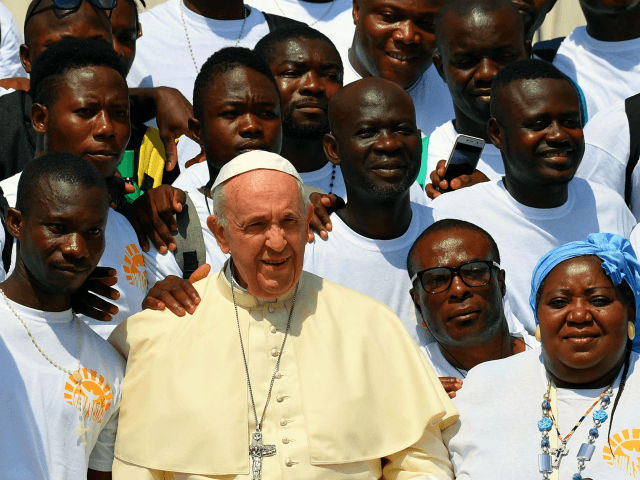
Pope Francis has been very outspoken on the highly debatable topic of immigration over the course of his pontificate these past six years. Many of us already know this is a hot button issue, one that is very popular and very divisive both in our secular culture and from a political perspective. If we aren’t immigrants ourselves, it’s likely that some of our ancestors were. On the one hand I believe the consensus would be that we have safe and legal immigration with secure borders. What that looks like and how that is played out is another issue for the experts to work out. Rather than trying to give a simple answer to a complicated question about how can the immigration problem be best resolved, maybe the answer instead is found in asking a simple question. What Would Jesus Do (WWJD)? Would Jesus welcome the immigrant? Of course! Yes. He would welcome the migrant – “the stranger among us.” Why? Because, He loves, and so do we.
Aside from the politics of whether or not to put up walls, what does the leader of the Catholic Church have to say about immigration while taking into account Church teaching? Below are some tweets and quotes given by the Holy Father, followed by what the Catechism of the Catholic Church states, and concluding with some clear teaching from two important Church documents that can guide us in the right direction and shed some much-needed light from the religious realm on this critical topic. Peace.
– Fr. Jeff
“Migrants are first of all human persons, and that they are the symbol of all those rejected by today’s globalized society.” – Pope Francis Tweet
“These least ones are abandoned and cheated into dying in the desert; these least ones are tortured, abused and violated in detention camps; these least ones face the waves of an unforgiving sea; these least ones are left in reception camps too long for them to be called temporary.”- Holy Mass for Migrants – Homily of His Holiness Pope Francis – Altar of the Cathedra in Saint Peter’s Basilica – Monday, 8 July 2019; (Sources: Euro News; Vatican)
“The Church without frontiers, Mother to all, spreads throughout the world a culture of acceptance and solidarity, in which no one is seen as useless, out of place, or disposable.” – Message for the 2015 World Day of Migrants and Refugees, September 3, 2014, by Pope Francis
“The Church is Mother, and her motherly attention is expressed with special tenderness and closeness to those who are obliged to flee their own country and exist between rootlessness and integration.” – Address to the Participants in the Plenary of the Pontifical Council for the Pastoral Care of Migrants and Itinerant People, May 24, 2013, by Pope Francis; (Source: Vatican)

+++++++++++++++++++++++++++++++++++++++++++++++++++++
Catechism of The Catholic Church (CCC) #s 2241, 2433
2241 The more prosperous nations are obliged, to the extent they are able, to welcome the foreigner in search of the security and the means of livelihood which he cannot find in his country of origin. Public authorities should see to it that the natural right is respected that places a guest under the protection of those who receive him. Political authorities, for the sake of the common good for which they are responsible, may make the exercise of the right to immigrate subject to various juridical conditions, especially with regard to the immigrants’ duties toward their country of adoption. Immigrants are obliged to respect with gratitude the material and spiritual heritage of the country that receives them, to obey its laws and to assist in carrying civic burdens.
2433 Access to employment and to professions must be open to all without unjust discrimination: men and women, healthy and disabled, natives and immigrants. For its part society should, according to circumstances, help citizens find work and employment.
+++++++++++++++++++++++++++++++++++++++++++++++++++++
Two Important Church Documents on Immigration:
1. Rerum Novarum (“of New Things” or Rights and Duties of Capital and Labor) – A letter written by Pope Leo XIII in 1891
1st Principle: People have the right to migrate to sustain their lives and the lives of their families.
Second Principle: A country has the right to regulate its borders and control immigration.
Third Principle: A country must regulate its borders with justice and mercy.
2. “STRANGERS NO LONGER: Together on The Journey of Hope”
– About migration in light of Catholic Social Teaching
The bishops, reflecting on Catholic social teaching on migration in the past, reformulate the teaching into five main points.
- All people have a right to find opportunity in their homeland (§34)
- All people have a right to migrate in order to support themselves and their families (§35)
- Nations have the right to control their borders (§36)
- Refugees and asylum seekers should be protected by the international community (§37)
- The dignity and human rights of undocumented migrants should be protected (§38)
- The bishops go on to insist that the person’s right to migrate and the nation’s right to control its borders are complementary. The state may impose reasonable limits on migration based on the common good, but the common good ceases to be served when the individual’s human rights are violated. Thus, the bishops claim that, in the present climate, the presumption must be in favor of the person’s right to migrate (§39).
Pastoral challenges for the Church:
* The bishops call the Church toward three things: conversion, communion, and solidarity. In the movement toward conversion, they call on Church members to lead and undergo a conversion of mind and heart, “confronting attitudes of cultural superiority, indifference, and racism” and accepting migrants as persons with dignity and rights (§40). In the movement toward communion, they insist that conversion leads to communion, which involves a serious spirit of hospitality (§41-42). Finally, in the movement toward solidarity, the bishops call on leaders of their local churches at all levels to lead the faithful in promoting justice, denouncing injustice, and put themselves on the line courageously defending the basic human rights of migrants (§43). The bishops go on to call for a comprehensive and collaborative pastoral response of the Church to migrants.
Sources: United States Conference of Catholic Bishops (USCCB) and Wikipedia
Previous Blog Posts on Immigration:
- “A Stranger and Your Welcomed Me” – Part 1 of 4
- “A Stranger and You Welcomed Me” (Mt. 25:35) – Part 2 of 4
- “A Stranger and You Welcomed Me” (Mt. 25:35) – Part 3 of 4
- “A Stranger and You Welcomed Me” (Mt. 25:35) – Part 4 of 4


 "Speak The Truth with Love," A Catholic Blog by Fr. Jeff Allan
Thank You, Fr. Jeff!Shar
LikeLike