May Day! May Day! The month of May is finally here!!! Yay!!! We have waited here in the “D” (Detroit) for the weather to transition to warmth, and our time for patience has truly been tested. This is also a time, whether school is out or not, to start planning our spring and summer journeys, particularly the journey of taking a pilgrimage. We are all pilgrims on a journey in this life knowing that our true destination and citizenship is in heaven, says St. Paul in his letter to the Philippians (Phil. 3:20). But God has also blessed us with the gift of enjoying the combination of his creation, our faith, and the rich history of our Tradition in the form of a pilgrimage, and this is an opportunity to take advantage of the time we have right now. So let’s stop procrastinating and start planning!
What initially comes to mind when you think of a pilgrimage? Pilgrims at Thanksgiving? The first pilgrims did travel across the ocean until they landed in Plymouth to have the first Thanksgiving Dinner with the Wampanoag Indians in November of 1621 (Source: History). But what may also come to mind when you think of a pilgrimage from a spiritual standpoint is traveling thousands of miles to a foreign land like missionaries once did and still do. For example, you might envision journeying on a long and arduous path like “The Way of St. James,” walking the Camino de Santiago tens or even hundreds miles all the way to Santiago de Compostela in Spain. An optimistic mind says, “I can do that!” But while your mind says one thing, your body may say another.
While I can say I have never walked the Camino, I have been blessed to leave the country and venture on a few other, faith-based, Marian pilgrimages which included seeing the tilma of Our Lady of Guadalupe in Mexico City; being refreshed by the cool waters of Lourdes, France which was famously known for when the Blessed Virgin Mary appeared to St. Bernadette back in 1854, and I was blessed to make a pilgrimage to Fatima, Portugal where Mary appeared to three children back in the early 20th century.
You don’t have to cross the Atlantic to enjoy a pilgrimage. Instead, one can make a local, religious pilgrimage right in one’s “own backyard”…almost 🙂 Here’s one objection: Not all of us can afford to take the time or travel or even have the physical capacity to go the distance on a pilgrimage. That may be true. So the conflicts may either be time, money, and/or health. One super, easy solution is to check out some photos on Google or watch a Youtube video and simply go on an e-pilgrimage. But experiencing an actual pilgrimage is much more enriching. A good challenge and more easily, attainable goal is to travel a short distance of less than an hour or even a half hour from home (that is, of course, if you are within close proximity to Detroit) and make the journey of a pilgrimage worth it all.
There are arguably many exquisite and ornate churches in the “D” – city gems – that are definitely worth seeing at some point in your life if you already haven’t done so (and I highly recommend to experience them in the context of a Mass) including churches like St. Joseph Oratory (here or here), Mother of Divine Mercy Parish: St. Josaphat (here or here) and Sweetest Heart of Mary (here or here) sites, and Old St. Mary’s in Greektown (here or here) along with many others as well as Sacred Heart Major Seminary. Speaking of some of these gorgeous churches, the Archdiocese of Detroit (AOD) is leading a wonderful, city pilgrimage on June 1st for a small fee of only $35.00. To review the itinerary or consider attending please call 866-550-1081, or go to the following web address: Detroit Churches – Day Pilgrimage.
Being raised in metro Detroit, here are the Fab 5 Sites that one can journey to on local pilgrimage, which can both deepen your prayer life and continue to maintain your heart in a spirit of joy this Easter season. They are captured below in descending order:
#5. Gravesite of Fr. John Hardon S.J.


Who: Servant of God, Fr. John Hardon S.J.
What: Gravesite
Where: Columbierre (Jesuit) Conference & Retreat Center in Clarkston, MI
Why: This holy priest was a faith-filled man who deeply loved Jesus Christ and his Catholic Church along with having a strong devotion to Mary and the Eucharist. Fr. Hardon was also an adviser and close associate to three future saints: St. Paul VI, St. John Paul II, and St. Teresa of Calcutta. He was also a profound catechist and teacher of the Catholic faith who authored multiple books including the well-known, Modern Catholic Dictionary, The Catholic Lifetime Reading Plan, and The Question and Answer Catholic Catechism. There is a treasure full of wisdom found in these books and other writings of his including the different topics he was inspired to write about located at the “Real Presence” website given below. Feel free to take a friend, and go to Columbierre to enjoy the beauty of the retreat center grounds and pray in the Jesuit Cemetery in front of Fr. John Hardon’s grave. Take Holy Scripture with you. But also for spiritual reading purposes, feel free to take some of his inspired writings to meditate and reflect upon.
Web: Columbierre, The Michigan Catholic, The Real Presence, Wikipedia
#4. Ste. Anne Parish de Detroit


What: Ste. Anne Parish
Where: Detroit, MI
Why: Dedicated to the grandmother of Jesus, who is also the Mother of Mary and the patroness of the Archdiocese of Detroit, Ste. Anne Parish was founded in 1701 and is the second oldest continuously operating parish in America (preceded by St. Augustine in Florida).
During St. Anne’s tenured history of 300 + years, the parish suffered a devastating fire back in 1805. The famously known pastor of the time, Fr. Gabriel Richard, who co-founded the University of Michigan, is known for proclaiming a Latin phrase which later became known as the seal and motto for the city of Detroit. It states: “Speramus meliora; resurget cineribus,” which translates, “We hope for better things; it will rise from the ashes.” Fr. Richard also brought the first printing press to Detroit in 1809, was elected as a territorial delegate to Congress on September 4th, 1823, and took his seat on December 8th. On April 26th, 1824, he began his famous motion to build a long road between Detroit and Chicago, known as Michigan Avenue (U.S. 12). Fr. Richard’s final resting place is at Ste. Anne, and his tomb can be visited there in the chapel.
On July 26, 2018, Archbishop Allen Vigneron announced that he is asking Pope Francis to designate Ste. Anne Church as a minor basilica. If Pope Francis accepts the application, Ste. Anne Church will become the first and only basilica in the city of Detroit, and one of only three basilicas in Michigan.
#3. Cathedral of The Most Blessed Sacrament


What: Cathedral of The Most Blessed Sacrament
Where: Detroit, MI
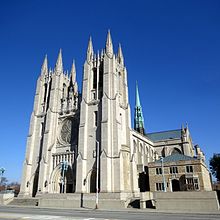
Why: The Cathedral of the Most Blessed Sacrament is a decorated, Gothic Revival-style Roman Catholic Cathedral Church and is the seat of the archbishop of the Roman Catholic Archdiocese of Detroit. The parish was founded in 1905, and construction began in 1913. While the interior was finished in 1930, the exterior, including the Twin Towers, were not completed until 1951. Plans for a redesign of the interior of the cathedral began in 1985 until the renovation was completed in the early 2000’s with one of they key features being the radiant stained-glass windows. Pope John Paul visited the cathedral on September 18th, 1987, and the cathedral was honored to be put on the U.S. National Register of Historic Places on August 3rd, 1982.
Two cathedral events that I recommend for people to put on their Catholic Bucket List, whether it be this cathedral or any Catholic Cathedral in the world, is to attend a Chrism Mass and Priestly Ordination Mass. The Chrism Mass takes place once per year on Holy Thursday in which representatives attend from each parish church within the diocese. The (arch)bishop blesses three Holy Oils (1). for the sick/infirm, 2). the catechumenate – those to be baptized, and 3). the chrism – used for the second anointing of oil at baptism, for the Sacrament of Holy Orders to the Priesthood, and for Confirmation), and they are taken back to each parish to be used throughout the year. The other annual event that I recommend to attend is a priestly ordination Mass (on the Saturday of each Pentecost weekend in Detroit) in which transitional deacons are ordained to the Catholic Priesthood of Jesus Christ. While these two powerfully moving liturgies are lengthy, ranging from two to three hours long, they are very joyful and full of spiritual richness and Tradition.
#2. National Shrine of The Little Flower Basilica


What: National Shrine of The Little Flower Basilica
Where: Royal Oak, MI off Woodward Ave.
Why: This is a national shrine in honor of “The Little Flower,” St. Therese of Lisieux, who lived a heroic and holy life as a contemplative, Carmelite Nun in France and was called home to God on September 30th, 1897 from her convent at the young age of 24 from Tuberculosis.
The Shrine of The Little Flower Parish was founded in 1925, and construction of the Shrine began a year later in 1926. Two weeks after construction began, the Ku Klux Klan burned a cross in front of the church. Like Ste. Anne Parish in Detroit which faced a fire in 1805, Shrine too faced a fire. The original wood structure of the Shrine, completed in two stages, was destroyed by a fire on March 17, 1936.
The current structure of the Shrine, which is a lavish, zig-zag Art Deco style, began in 1931 and was completed in 1936. One of the key features on the exterior structure is the Charity Crucifixion Tower, which measures 28 feet high (8.5 m) facing Woodward Ave. It was built as a response to the Ku Klux Klan as a “cross they could not burn.” Construction for the new Shrine was funded by the proceeds from the radio ministry of the controversial Father Charles Coughlin who broadcast from the tower during the 1930s. At the upper corners of the tower are symbols of the Four Evangelists. Carved below the feet of the figure of Christ are the Seven Last Words from the Cross. Just below them is a doorway with “Charity” and “Christ Crucified” carved above it. On the interior of the Shrine the octagonal nave seats three thousand on two levels, with the altar in the center. The main building is granite and limestone, with exterior and elaborate interior sculptural work including a lectern and Stations of the Cross, and hand-painted murals.
In 1998, the United States Conference of Catholic Bishops (USCCB) declared the site a National Shrine, one of only five in the country according to the church’s web site. Then on Dec. 23rd, 2014, Pope Francis granted National Shrine of the Little Flower the honorary title of “Minor Basilica.” The following month on January 23rd, 2015 Detroit Archbishop Allen H. Vigneron announced that the Holy Father, Pope Francis, granted the title of Minor Basilica to the National Shrine of the Little Flower Church in Royal Oak.
#1. Solanus Casey Center


Who: Blessed Solanus Casey
What: Solanus Casey Center
Where: Detroit, MI
Why: This humble man, who is one step away from being canonized a saint in the Catholic Church, was born in 1870 as Bernard Francis Casey, nicknamed “Barney” and was the sixth of 16 children. He later professed the religious name, Solanus, named after the 16th and 17th century St. Francis Solanus, a Spanish Friar and missionary from South America. Solanus was raised in the state of Wisconsin, later served in New York, and then moved to Michigan at the St. Bonaventure Monastery in Detroit where he accepted the role of a doorkeeper-receptionist, also known as a “porter.” Solanus had at least three “loves” in his life: a love to kneel quietly and pray in front of the Blessed Sacrament, a love for people, and a love for playing his violin. But what Solanus may have been lacking as a simplex priest in which he could not hear confessions or preach doctrinal sermons, he made up in an enormous way with his love for people in serving the poor and hungry and counseling the needs of thousands, all the while being an instrument of God’s healing power over the course of many years in his faithful ministry as a Capuchin Friar. You can learn more about his life through a tour at the Solanus Casey Center in Detroit where one can also view and kneel quietly in front of his tomb for intercessory prayer.
There are life-sized statues of well-known people in our faith symbolizing the Corporal Works of Mercy to greet you as you enter the center. There is also a beautiful chapel with a bone relic of Solanus that prominently stands in the back, a gift shop, rooms for reading and eating meals including a large sitting room for presentations and discussions, a beautiful garden, and confessions are available too. More building and renovations are being planned to further anticipate and enhance the center to accommodate a greater number of pilgrims.
Web: Solanus Casey, Solanus Center, Wikipedia
Q: Do you have a favorite place you visited while on pilgrimage either in Detroit or somewhere else? If so, what is the name of the site and why? Leave a reply.
*Bonus:*
“Spiritual, but not religious?” Click on the link below to read about Fr. Mike Schmitz’ response to this strange but common belief today: Bulldog Catholic

 "Speak The Truth with Love," A Catholic Blog by Fr. Jeff Allan
I am happy to say that we have visited four of the fab five sites you listed as well as a couple of the honorable mentions, the churches. St. Joseph Oratory was by far the most interesting and humbling experience. I really enjoyed all the ceremony and tradition: the Latin, the 15+ altar servers, the chanting, the elevated ambo, the quiet. We also make it a point to tour a cathedral and attend mass while traveling. We most recently attended mass at the Basilica of the National Shrine of the Immaculate Conception in Washington D.C. and a rural church in Waialua, HI that shares the same name as our own church here at home. The latter was so interesting in that they used white wine for the Eucharist and the “choir” consisted of a guitar and an assortment of Hawaiian drums. In the future, we would love to be able to attend mass in another country.
LikeLiked by 1 person
A great list! I think every Catholic in the Detroit area should visit the Solanus Casey Center at least once. I am blessed to be able to go there almost once a month.
LikeLiked by 1 person
I would love to be able to make a pilgrimage to all of these sites, but especially the National Shrine of the Little Flower Basilica. It’s where my maternal grandmother was brought into the Faith as a convert in the late 1930s, possibly early 1940s. My mother isn’t sure of the year. Having seen pictures of the interior, I’ve wondered if it looked like that when she was baptized. Even if she was baptized at the wooden structure that burned, it’s still the site of the Shrine where she came into the Faith, and why she named my mother Theresa, and why I gave my own daughter Rose as a middle name.
LikeLiked by 1 person