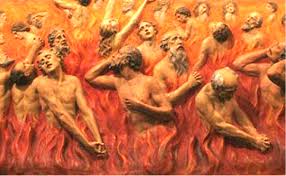
When we die we will ultimately end up in either one of two places: heaven or hell. Hopefully, by God’s grace and mercy, we go to the former. However, there is something after death that we may need to pass through in order to enter into heaven. The journey to heaven, though a one-way ticket in and through Jesus Christ, may not always be a direct flight. There may need to be a stop on the way that includes purification before enjoying the Beatific Vision of God for all eternity. What is this state of being purified and purged before seeing God and being in heaven? This often forgotten and misunderstood state is called Purgatory. The positive thing about it is that we are guaranteed salvation, and for that reason, is a better place to be since we are still working out our salvation with fear and trembling (Phil. 2:12) as the Church Militant here on earth. The negative part is that Purgatory involves suffering, which is the reason why it is called the Church Suffering (while those in heaven are called the Church Triumphant). This suffering is considered to be a purifying fire of love, which is an act of mercy by Almighty God.
Purgatory is a state of being in the next life where souls, while guaranteed salvation, still work out their salvation through purification from sin and earthly detachment. We will be like gold tested in fire, in need of being purified of the elements. “He (God) will be like a refiner’s fire” (Mal. 3:3) for “I will test them as one tests gold” (Zec. 13:9). Purgatory is also a temporal punishment due to sin even though the sin may have already been forgiven through the Sacrament of Reconciliation. The Catechism states: ”All who die in God’s grace and friendship, but still imperfectly purified, are indeed assured of their eternal salvation. But after death they undergo purification, so as to achieve the holiness necessary to enter the joy of Heaven” (Catechism 1030).
This is not a new concept but has been part of the Tradition and history of the Catholic Church for centuries. In the year 211, for example, one can read through the writings of Tertullian that Christians prayed and sacrificed for the deceased, particularly on the birthdays and anniversaries of the dead. St. Augustine, who lived in north Africa in the fourth and fifth centuries, said that the same fire that tortures the damned “purifies the elect.” In addition, the teaching on Purgatory was formally accepted in the Middle Ages. It was officially recognized in a letter by Pope Innocent IV in 1254. It was also addressed at the II Council of Lyon in 1274, the Council of Florence in 1439 as well as at the Council of Trent in 1563.
Although many don’t believe in Purgatory, it was originally accepted by Martin Luther, the founder of Lutheranism. One of the books of the Bible that Protestants got rid of during the Protestant Reformation in the 16th century was II Maccabees. In that book, there is a reference for almsgiving and prayers for their deceased that were offered up by Judas Maccabaeus and his soldiers (II Mac. 12:42-46). The Maccabees were a Jewish rebel army who ruled from 164 B.C. – 63 B.C. So there is scriptural evidence that ancient Jews prayed for those in the afterlife, and praying for the deceased was also an established part of their synagogue ritual too. We Catholics offer up prayers for the dead based on this scripture and others, and we also believe that to offer up prayers including the greatest prayer of the Mass can help our beloved deceased who may be in purgatory and in need of our prayerful assistance.
Another scriptural-historical example that helps us understand the teaching on Purgatory occurred at the event of the death of an Israelite king. When the soldiers of Jabesh discovered King Saul’s body and the bodies of his two deceased sons, they burned their bodies. Cremation was not an Israelite custom. On the other hand, cremation is acceptable in the Catholic Church provided there is a steadfast belief in the Resurrection of the body on the last day. Perhaps due to the damaged state of the bodies, necessity may have prompted the soldiers of Jabesh to cremate (Source: New American Bible). Afterward, the Jabesh soldiers buried the bones and fasted for seven days (1 Sam. 31:11-13). This leads us to believe that fasting is efficacious for the dead too, especially if the souls are in purgatory, and therefore would benefit the deceased in the afterlife on their path to heaven. So prayer, fasting and almsgiving, a theme of Lent, which can be practiced any time of the year, can help our beloved deceased.
Souls in heaven or in hell can’t benefit from our prayers since they are in a fixed, perpetual and eternal state. One group is saved while the other is damned. However, our prayers for them may be used for other souls on earth, in purgatory or for a good cause. Then why does Scripture and our faith recommend to pray for the dead? Our prayers are helpful to those souls being purged in purgatory as they journey toward heaven and prepare to be consumed by the Holy Trinity’s unconditional love. While we pray for souls in purgatory, know that they can pray for us but can’t help themselves. They depend on our prayers and sacrifices. So who is saved, damned or in purgatory? We don’t know who is in purgatory or in hell (besides the devil and fallen angels known as demons). But we do know some of the souls in heaven? Elijah – 2 Kgs 2:11, St. Joseph, St. Peter, St. Therese of Lisieux and her parents, Louis and Zelie Martin, who were canonized back on October 18th. At a Catholic funeral it should not be interpreted or perceived that deacons, priests or bishops canonize souls. The Church has its own rigorous yet effective way of qualifying deceased souls to be saints in heaven that are recognized on earth through the approval of two miracles. We always pray with faith in Jesus, in his Resurrection and in God’s love and mercy for our beloved deceased to be welcomed into heaven.
Why is this topic of Purgatory being addressed? It is because of the timeliness of it. We celebrate All Saints on Sunday, Nov. 1st and All Souls on Nov. 2nd in which we continue to remember and pray for our beloved deceased including the whole month of November. If interested in learning more, you are invited to watch a DVD-video presentation entitled, “Purgatory: Uncovering the Mystery, Meaning and Hope.” It will be shown Saturday, Nov. 14th, 2 – 3:30pm in the library and will feature a Q & A session at the conclusion. All are invited.
* Note: Some of the details gathered for this article came from Michael Brown’s website, spiritdaily.com and his book, Afterlife.
In Jesus, Our Hope, Our Resurrection and Our Life,
Fr. Jeff Allan
Resources:
Scripture: 1 Sam. 31:11-13, 2 Mac. 12:42-46, Job. 1:5, Prv. 17:3, Is. 1:25, 48:10; Zec. 13:9, Mal. 3:2-3, Mt. 5:26, Lk. 12:59, 1 Cor. 3:13-15, 1 Pt. 1:7, Rev. 21:27
Catechism: 958, 1030-1032, 1472
Web: http://www.spiritdaily.com/Afterlife2015c.htm , http://www.spiritdaily.com/Afterlife2015d.htm

 "Speak The Truth with Love," A Catholic Blog by Fr. Jeff Allan