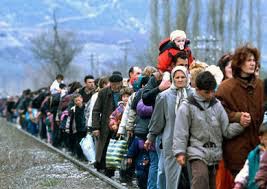
Below are the three remaining topics to be covered on the refugee-migrant crisis: They are as follows:
1). A short Q & A with our U.S. Bishops,
2). How the bishops view the government’s role, and
3). A list of resources.
While there are several ways to look at this crisis, whether it be economically, politically, or otherwise, the bishops give us a good lens to look through from a spiritual point of view. First, what light can our bishops shed on this timely, heated and yet controversial topic? Here is a list of five Frequently Asked Questions About Comprehensive Immigration Reform.
1. Do the U.S. bishops support any particular legislation to repair our broken immigration system?
Yes. On July 19, 2005, Bishop Gerald R. Barnes, chairman of the U.S. Conference of Catholic Bishops’ Committee on Migration, announced support for the Secure America and Orderly Immigration Act of 2005 (S. 1033, H.R. 2330), introduced by Senator John McCain (R-AZ) and Senator Edward M. Kennedy (D-MA) in the U.S. Senate (co-sponsors) and Representatives Jim Kolbe (R- AZ), Jeff Flake (R- AZ), and Luis Gutierrez (co-sponsors) in the House of Representatives. The legislation includes many of the elements outlined by the U.S. bishops, including an earned legalization program, a temporary worker program with worker protections, and reductions in backlogs for family-based visa categories.
2. Do the U.S. bishops oppose any immigration legislation which has been introduced in Congress?
Yes. The U.S. bishops strongly oppose H.R. 4437, the Border Protection, Anti-Terrorism, and Illegal Immigration Protection Act of 2005, introduced by Representative James Sensenbrenner (R-WI) and Representative Peter King (R-NY). H.R. 4437 passed the House of Representatives 239-182 on December 16, 2005. The legislation includes many harsh provisions which would bring undue harm to immigrants and their families. Among its many provisions, it would make unlawful presence a felony; subject anyone who assists an undocumented alien to criminal penalties; require mandatory detention of all aliens apprehended along the U.S. border, including children and families; and limit relief to asylum-seekers through an expansion of expedited removal.
3. Why is the Catholic Church involved in the immigration issue?
There are several reasons the Catholic Church is involved in the immigration debate. The Scriptures as well as Catholic Social Teaching, form the basis of the Church position. In Matthew, Jesus calls upon us to “welcome the stranger,” for “what you do to the least of my brethren, you do unto me” (Mt: 25-35, 40). The Church also is involved in the issue because many of the Catholic faithful are immigrants who need the support and assistance of the Church. Finally, the U.S. bishops believe that our current immigration system contributes to the human suffering of migrants and they have a duty to point out the moral consequences of a broken system.
4. Does the Catholic Church believe in “open borders?”
No, Church teaching supports the right sovereign nations have to control their borders. Enforcement of our borders, however, should include the protection of the basic human rights and dignity of the migrant and not place lives at risk.
5. Does the Catholic Church support illegal immigration?
No. The Catholic Church does not support or encourage illegal immigration because 1) it is contrary to federal law and 2) it is not good either for society because of the presence of a large population living outside the legal structures or the migrant, who is subjected to abuse, exploitation, and death in the desert. Instead, the Church is advocating changing a broken law so that undocumented persons can obtain legal status in our country and enter the U.S. legally to work and support their families.
Source: http://www.usccb.org/issues-and-action/human-life-and-dignity/immigration/frequently-asked-questions-comprehensive-immigration-reform.cfm
Second, how do the bishops view the government’s role in the refugee-migrant crisis? “The U.S. Catholic Bishops accept the legitimate role of the U.S. Government in enforcing immigration laws…in intercepting undocumented migrants who attempt to travel through or cross into the country.” The U.S. Bishops made clear, however, that “we do not accept some of the policies and tactics that our government has employed to meet this responsibility” (#78). Source: http://www.usccb.org/issues-and-action/human-life-and-dignity/immigration/churchteachingonimmigrationenforcement.cfm.
In addition, “the USCCB opposes ‘enforcement only’ immigration policies and supports instead comprehensive immigration reform which includes an enforcement component. In a 2003 pastoral letter on migration called, Strangers No Longer, the U.S. Catholic Bishops outlined the elements of their proposal for comprehensive immigration reform. These include: earned legalization; a future worker program; family‐based immigration reform; restoration of due process rights; addressing root causes of migration; and enforcement measures which adhere to the following three principles: targeted, proportional and humane.
Source: http://www.usccb.org/issues-and-action/human-life-and-dignity/immigration/churchteachingonimmigrationenforcement.cfm
The USCCB also believes that in the process of so enforcing those laws, the U.S. government must protect the human rights and dignity of all migrants, with particular consideration for the most vulnerable of those migrants – including refugees, asylees, and unaccompanied minors (children)…The U.S. Bishops believe that the conditions for processing and holding children upon apprehension should be appropriate for children – providing at a minimum adequate food and drinking water, medical assistance, clean and dry clothes, toilets and sinks, adequate temperature control and ventilation, supervision to protect them from others, and separation from unrelated detained adults… all unaccompanied alien children apprehended at the border should be screened to determine whether they may be victims of trafficking or fear persecution. Further, unaccompanied alien minors removed from the U.S. should be protected from potential trafficking by ensuring their safe repatriation (return).”
Source: http://usccb.org/issues-and-action/human-life-and-dignity/migrants-refugees-and-travelers/vulnerablemigrantpopulations.cfm
The Michigan bishops, through the Michigan Catholic Conference (MCC) also have something to share. “Should our state policy-makers pursue immigration legislation, their deliberations must:
▪ Uphold the human dignity of all persons and work against any injustice which would compromise the dignity of immigrants, and
▪ Recognize and promote the values that immigrants provide to Michigan’s culture and economy.
The Catholic Church teaches that each person has dignity and the right to basic human necessities. Individuals therefore have the right to migrate in order to secure those needs for themselves, and their families. At the same time, immigrants must also respect and abide by the laws and traditions of the countries in which they reside…” Source: http://www.micatholic.org/advocacy/advocacy-issues/immigration/
In terms of immigration reform, the Catechism instructs the faithful that good government has two duties, both of which must be carried out and neither of which can be ignored: 1). Welcome the foreigner out of charity and respect for the human person, and 2). To secure one’s border and enforce the law for the sake of the common good.” Source: Catechism 2241, http://www.usccb.org/issues-and-action/human-life-and-dignity/migrants-refugees-and-travelers/vulnerablemigrantpopulations.cfm
In 1999, Pope John Paul II called for a “new evangelization” centered on the person of Jesus Christ. He said, ”‘The encounter with the living Jesus Christ’ is ‘the path to conversion, communion and solidarity'” (#7). Such an encounter, so central to all our Jubilee Year activities, leads to a daily vision of the risen Lord, present and active in the world, especially in the poor, in the stranger, and in the migrant and refugee. These immigrants, new to our shores, call us out of our unawareness to a conversion of mind and heart through which we are able to offer a genuine and suitable welcome, to share together as brothers and sisters at the same table, and to work side by side to improve the quality of life for society’s marginalized members. In so doing, we work to bring all the children of God into a fuller communion, ‘the communion willed by God, begun in time and destined for completion in the fullness of the Kingdom’” (Ecclesia/Church in America, #33).
Source: http://www.usccb.org/issues-and-action/cultural-diversity/pastoral-care-of-migrants-refugees-and-travelers/resources/welcoming-the-stranger-among-us-unity-in-diversity.cfm
In conclusion, the refugee-immigrant crisis is a call and opportunity for all of us to work in the Kingdom now, the “already,” but also moving toward the Kingdom, the “not yet.” Though a nation has a right to control and defend its borders, it’s also important to remember that Jesus calls us to welcome the stranger in the refugee and immigrant among us as he would. May we work together to bring about the relief, healing and love needed for this important issue of our time in Jesus’ most holy name. Amen.
– Fr. Jeff Allan
“All, therefore, belong to one family, migrants and the local populations that welcome them, and all have the same right to enjoy the goods of the earth whose destination is universal.” —Pope Benedict XVI
Addendum: According to Catholic Charities of Southeast Michigan CEO Jason Shanks, CCSEM is looking to relocate some Syrian refugees to metro Detroit, and the first few have just arrived. This was stated at the Presbyteral Council Meeting at Sacred Heart Major Seminary on October 12th, 2015. Catholic Charities is not only looking to receive a collection of home goods and clothing for these people. But the greater need at this time is to provide housing and find host families while screening people in the process. In 2014, CCSEM resettled 687 refugees, primarily Chaldeans from Iraq. These individuals and families primarily reside in Macomb, Oakland and Wayne Counties. Source: CCSEM pamphlet
Resources:
1. Bible: Mt. 25:35, Jn. 11:52, 1 Cor. 12:13, Lk 14:23, Rev 7:9, Rom. 8:35-39
2. Catechism: #2241, 2433
2241 The more prosperous nations are obliged, to the extent they are able, to welcome the foreigner in search of the security and the means of livelihood which he cannot find in his country of origin. Public authorities should see to it that the natural right is respected that places a guest under the protection of those who receive him. Political authorities, for the sake of the common good for which they are responsible, may make the exercise of the right to immigrate subject to various juridical conditions, especially with regard to the immigrants’ duties toward their country of adoption. Immigrants are obliged to respect with gratitude the material and spiritual heritage of the country that receives them, to obey its laws and to assist in carrying civic burdens.
2433 Access to employment and to professions must be open to all without unjust discrimination: men and women, healthy and disabled, natives and immigrants. For its part society should, according to circumstances, help citizens find work and employment.
3. Ecclesia (Church) in America #7, 33 – Apostolic Exhortation by Pope John Paul II to The Bishops, Priests and Deacons, Men and Women Religious, and All The Lay Faithful on The Encounter with The Living Jesus Christ: The Way to Conversion, Communion and Solidarity in America, 1/22/99.
http://w2.vatican.va/content/john-paul-ii/en/apost_exhortations/documents/hf_jp-ii_exh_22011999_ecclesia-in-america.html
4. Michigan Catholic:
a. http://www.micatholic.org/advocacy/advocacy-issues/immigration/
b. http://www.micatholic.org/advocacy/news-room/news/michigan-bishops-statement-on-immigration/
c. In Statement, Michigan Bishops Urge Support for Immigrants, Undocumented Persons 8 – 3 – 11
http://www.micatholic.org/advocacy/news-room/news-releases/in-statement-michigan-bishops-urge-support-for-immigrants/
d. http://www.micatholic.org/assets/files/focus/focus_20080501-OnImmigration.pdf
5. Rerum Novarum – A letter written by Pope Leo XIII in 1891 on the rights and duties of capital and labor
First Principle: People have the right to migrate to sustain their lives and the lives of their families.
Second Principle: A country has the right to regulate its borders and control immigration.
Third Principle: A country must regulate its borders with justice and mercy.
Source: http://w2.vatican.va/content/leo-xiii/en/encyclicals/documents/hf_l-xiii_enc_15051891_rerum-novarum.html
6. Strangers No Longer Together on The Journey of Hope: A Pastoral Letter Concerning Migration from the Catholic Bishops of Mexico and the United States, 1-22-03. Source:
http://www.usccb.org/issues-and-action/human-life-and-dignity/immigration/strangers-no-longer-together-on-the-journey-of-hope.cfm
7. United States Conference of Catholic Bishops (USCCB) – http://www.usccb.org
a. http://www.usccb.org/issues-and-action/human-life-and-dignity/immigration/index.cfm
b. http://www.usccb.org/issues-and-action/human-life-and-dignity/immigration/catholic-teaching-on-immigration-and-the-movement-of-peoples.cfm
c. http://www.usccb.org/issues-and-action/human-life-and-dignity/immigration/churchteachingonimmigrationreform.cfm
d. http://www.usccb.org/issues-and-action/human-life-and-dignity/immigration/frequently-asked-questions-comprehensive-immigration-reform.cfm
e. http://www.usccb.org/issues-and-action/human-life-and-dignity/immigration/strangers-no-longer-together-on-the-journey-of-hope.cfm
f. http://www.usccb.org/issues-and-action/human-life-and-dignity/migrants-refugees-and-travelers/vulnerablemigrantpopulations.cfm
8. Welcoming The Stranger Among Us: Unity in Diversity, A letter from the U.S. Bishops, 11-15-00
http://www.usccb.org/issues-and-action/cultural-diversity/pastoral-care-of-migrants-refugees-and-travelers/resources/welcoming-the-stranger-among-us-unity-in-diversity.cfm

 "Speak The Truth with Love," A Catholic Blog by Fr. Jeff Allan