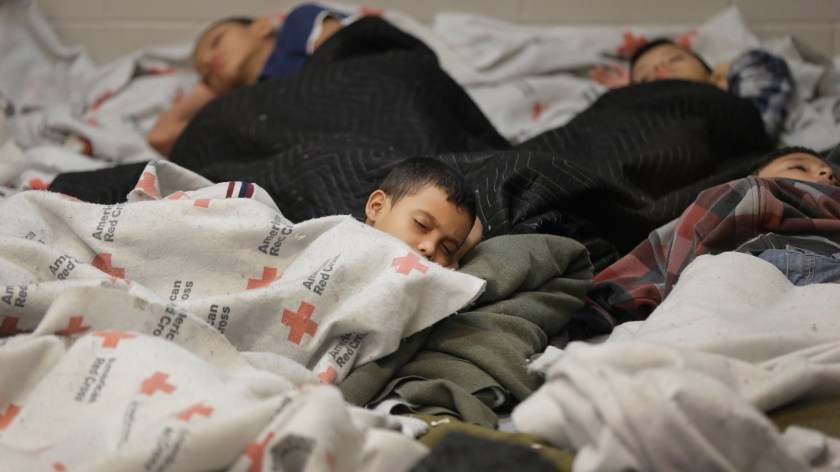
Refugee kids held up at a US Customs and Border Protection processing facility, in Brownsville, Texas, June 18, 2014. Courtesy: Reuters
“I was hungry and you gave me food, I was thirsty and you gave me drink, a stranger and you welcomed me” (Mt. 25:35). These are the words of Jesus that have become known as examples of the corporal works of mercy. While there has been much political debate in recent years over immigration and what to do about refugees, Pope Francis’ visit to our country last week reminded us from a spiritual standpoint the importance of love, compassion and generosity that we are called to offer to those strangers in need, namely immigrants and refugees who do not have a place to call home…yet, but who are under the disguise of Jesus looking to and waiting to be welcomed by you and me, by all of us who are members of the same human family in God, who has graciously entrusted creation and this bountiful but ailing earth to all of us.
In a statement made to a crowd in Philadelphia, Pope Francis told immigrants not to be discouraged stating: “By contributing your gifts, you will not only find your place here, you will help to renew society from within,” he said in Spanish. “I take this opportunity to thank all those, of whatever religion, who have sought to serve the God of peace by building cities of brotherly love, by caring for our neighbors in need, by defending the dignity of God’s gift of life in all its stages, by defending the cause of the poor and the immigrant,” he said. “All too often, those most in need of our help are unable to be heard. You are their voice, and many of you have faithfully made their cry heard.” Source: http://www.nbcnews.com/storyline/pope-francis-visits-america/pope-francis-philadelphia-tells-immigrants-do-not-be-discouraged-n434261
While some have faithfully made their cry heard, others may have concerns and respond, “where is the justice in someone who has gotten in line, committed to a process and has been waiting for years to become a U.S. citizen? Yet there are others who illegally and instantly cross one of the borders into this country and have the potential to become citizens through amnesty, for example.” You’re right. There is not any justice in that. Life isn’t fair. Realize that unlike many of us who live in love, peace and security, especially in this nation, there are many who do not share the freedoms and blessings in other countries that we do. Many immigrants and refugees flee from constant abuse, violence and drugs, and even death in search of a better life for them and their families. How that is to be resolved politically and practically is beyond the scope of my expertise. But I go back to a popular question that was asked often in Christian faith circles back in the 1990’s. It was an acronym commonly used. Do you remember what it was? The answer is W.W.J.D. What Would Jesus Do? What would Jesus do if he came across a child refugee from Syria or Iraq? What would he do if he encountered a lonely refugee from northern Africa who fled his or her hometown just captured from radical Islam (like from members of ISIS), and is trying to survive by going across rough waters in a poorly, made, wooden boat with overcrowded people hoping to arrive on the shores of either Greece or Italy and potentially face unwelcome by people as well as hostility from authorities? What would Jesus do if he came across an immigrant from any number of countries south of the border, for example? Would he not welcome them? Of course he would and with open, loving arms! Shouldn’t we do the same? He would be faithful to his own words… “a stranger and you welcomed me” (Mt. 25:35). What about welcoming the stranger in our own communities and neighborhoods? Many of you have responded to that through ministries like St. Vincent de Paul, B-WARM (Blue Water Area Rescue Mission) and others. God bless you for your generous efforts. We have a loving and welcoming God whom we are called to imitate in Christ Jesus, and we can surely be more welcoming with his grace and help.
In short, what can we do?
1). Educate ourselves (as more information and resources will be forthcoming in articles over the next three weeks);
2) Pray. Pray for the immigrants and refugees who are suffering with their families, but also pray to God to be a courageous witness on behalf of them;
3). Get more involved in the public square via policy making either through voting or writing your congressman or woman.
4). Be more compassionate to strangers and be more welcoming to visitors inside and outside of church.
If we are called to show compassion and love to immigrants and refugees, does that mean that all of them should automatically become legalized citizens? At the same time, doesn’t a country also have a right to secure its borders? What about illegal immigrants who do not pay taxes? Stay tuned as answers to these questions and more will be given over the next three weekends in subsequent articles. Some of these answers and other main points will be highlighted and referenced from statements made by our U.S. and Michigan bishops and will include resources to the Bible and the Catechism too.
In The Spirit of Always Welcoming The Stranger As Jesus Did,
Fr. Jeff Allan

 "Speak The Truth with Love," A Catholic Blog by Fr. Jeff Allan